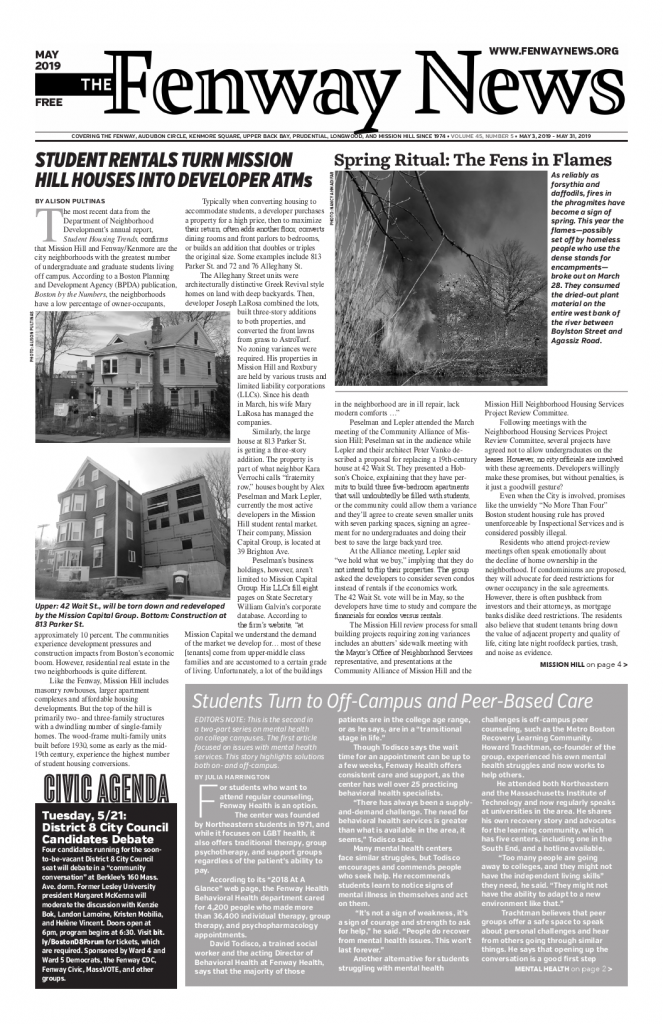
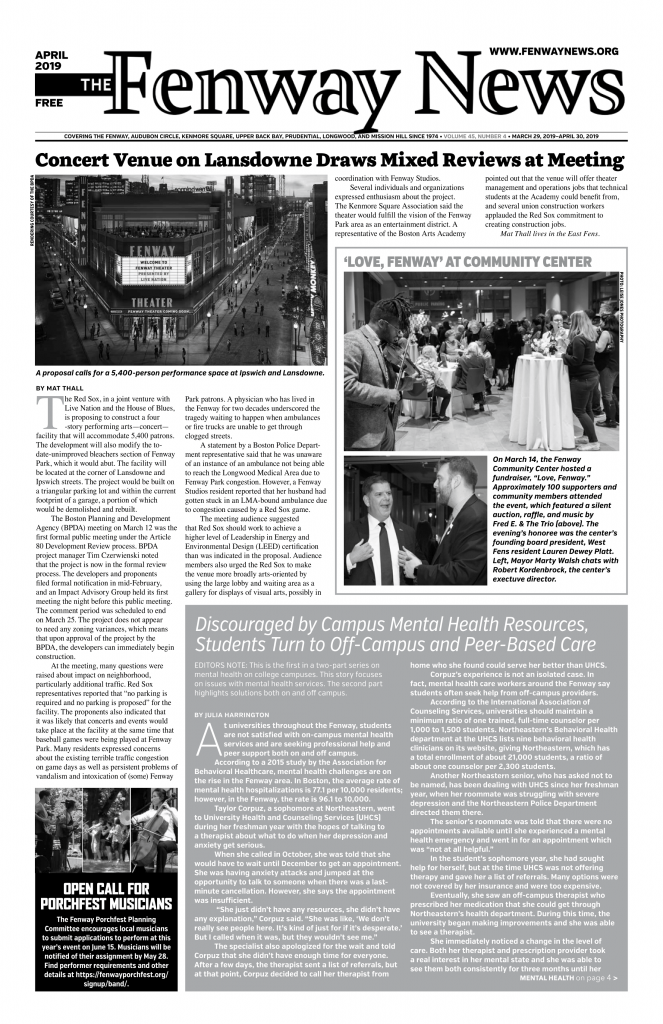
Prior to the preliminary election on Sept. 24, the Fenway News asked all five District 8 City Council candidates to answer four questions related to affordable housing, climate change, transit and bike infrastructure, and issues related to the Red Sox. Answers from the five candidates are below: Kenzie Bok’s answers are in blue, Montez Haywood’s are in purple, Kristen Mobilia’s are in orange, Jennifer Nassour’s are in red, and Hélène Vincent’s are in green.
Affordable housing remains an obstacle to the city’s economic health, to social equity, and to the economic success of tens of thousands of Boston residents (or would-be residents). What are two to three things the City can do to improve housing policy? These could be broad policies, such as instituting rent control, or specific steps, such as imposing a tax to discourage the purchase of high-cost housing units by nonresidents for investment purposes.
The fight for an affordable Boston, where people from all walks of life can continue to live, is what drove me to run for City Council. I have devoted myself to this cause as a citizen in a variety of ways—from helping to lead the successful Community Preservation Act campaign, which secured more funds for affordable housing, to working to preserve public housing at the Boston Housing Authority, to supporting affordable homeownership initiatives as a board member at the Massachusetts Affordable Housing Alliance (MAHA). I also teach a class at Harvard on “Justice in Housing”. I think the struggle to keep families of every background and seniors on fixed incomes in Boston is a struggle for the soul of the city, and there’s much we can do on a public policy front to diverge from the path that cities like San Francisco, Vancouver, and London have already traveled. I support the proposed transfer tax on high-value property sales, to discourage speculation (Nantucket and Martha’s Vineyard already have this in place), with proceeds to go to affordable housing. I think we should also think creatively about how to discourage the conversion of housing stock into vacant investment properties, and I will work for strong enforcement of new tight regulations on short-term rentals. I support the recent home-rule petition to increase IDP and linkage, and also support community-led efforts to deepen affordability of IDP units, increase their number, and insist that they stay on site. MAHA, in partnership with the City of Boston, the Massachusetts Housing Partnership (MHP), and the Greater Boston Interfaith Organization (GBIO), has just launched the ONE+ Boston Mortgage to make affordable homeownership more achievable in the city—I’d like to scale that up, especially in Mission Hill and Fenway, to anchor another generation of families in Boston and help close the racial wealth gap.
I think that to create long-term affordable housing that is more detached from the speculative market, we need to get creative about the use of public land, set up land trusts, and make it easier for cooperatives to function financially. I want to see us invest significant city capital in the preservation of public housing and the “project-basing” of new vouchers within Boston wherever possible (a method of anchoring more deeply-affordable units in the city). I was involved in such efforts at the Boston Housing Authority, and also in a policy change to allow low-income families to use their federal housing vouchers in more neighborhoods, including the higher-cost parts of the city such as many parts of District 8. I support Rep. Adrian Madaro’s bill to help seniors facing eviction due to major rent increases, and believe that we need to work with renters and owners to find ways to better stabilize tenancies in general, since eviction—and the family homelessness that often results—comes at enormous personal and public cost. As I’ve knocked doors across District 8, I’ve met many owner-occupant landlords who are continuing to charge below-market rents to long-time tenants in order to keep them in our community, and I’d like to find ways to support and incentivize such action, through property-tax reductions or other measures. I supported the Jim Brooks Act and was disappointed when the State House denied us its tools for data-collection about housing displacement; I also support a tenant right-to-counsel. We can only effectively tackle housing affordability by tackling it at every income level, thereby unshackling our whole economy by enabling people to allocate a more reasonable share of their income to rent. Keeping truly diverse communities in the city is an essential goal for me, and I will make it a focus of my work on behalf of District 8 on the City Council. -Kenzie Bok
I believe that the passage of the home rule petition requesting that the State grant the City of Boston the authority to change the tax linkage rate plays an important role in addressing the affordable housing needs of the City. The BPDA study that was completed last year stated that the tax linkage rate needs to be increased to ensure that we fund affordable housing in Boston. I will advocate that the Tax Linkage rate be increased and that increase be tied directly to the City’s affordable housing needs.
I will advocate that we address short term rentals in the City, and I believe that we should add a fee on short term rentals and use that revenue to fund affordable housing programs in the City.
To address our City’s affordable housing needs we will also need our surrounding Cities and towns to increase their housing stock. I support the Housing Choices Act that will allow the towns across Massachusetts to change zoning laws with a simple majority vote of that community to allow for additional construction along transit corridors to ensure that as the population density of the region grows the regions housing stock will grow to match demand. -Montez Haywood
We are currently in a housing crisis and need a plan for immediate stabilization. Boston home prices and rents have gone up 55% since 2005. Income of residents has been much flatter with people often allocating 50% of their income to housing costs. Rents are at record highs, we have lost a great deal of family and workforce housing, and the demand for a range of affordable housing is well beyond the supply.
We need to provide more opportunities for different types of housing such as rent-to-own situations and co-op buildings with a range of income levels. Developers need to commit to building affordable housing onsite (no more deals to pay more to build offsite). Also, we need to provide tax incentives for landlords to maintain housing at reasonable rents.
I feel strongly that universities and colleges should build dormitories within their own footprints. Local institutions are not the non-profit entities that they used to be, and they seem to have ample space to construct classroom and lab buildings, dining facilities, etc. but not housing. We need to reverse the trend of student housing taking over available family and workforce housing within our neighborhoods. This has driven up rents, increased property taxes, pushed out longtime renters and homeowners, and kept new non-transient residents from calling our city home.
In addition, I would advocate for non-US purchasers to pay an increased Property Transfer Tax in the range of 15-20%. This has proven to be effective in cities like Vancouver that are in the midst of a major housing crisis. With luxury buildings like One Dalton being used by the elite as wealth storage, we are sacrificing opportunities to provide a range of affordable housing for people who actually live in, work in, and contribute to our neighborhoods.
For many years, I have advocated for affordable housing, participating in community development meetings across our District 8 community. In the end, we have stronger and more successful neighborhoods when we have engaged communities. We all do better and are safer when residents know each other, support each other, and are able to grow and age in community. -Kristen Mobilia
Keeping our neighborhoods affordable for a diverse range of incomes should be a priority for the City Council. I am not in favor of rent control, which can lead to disinvestment in our neighborhoods and higher property taxes. I am in favor of increasing the amount of workforce housing created within larger developments, as well as the creation of smaller units and transit-oriented development that does not require a parking space to be allocated for each unit. -Jennifer Nassour
I do think we need to look at all the possible avenues open to us in order to address our housing crisis, and we need to have short-term remedies in the mix as well as long-term solutions. Three specific things I would do are 1) revise and resubmit the original Jim Brooks Stabilization Act, which included non-binding mediation for large rent hikes and informing tenants’ rights groups about evictions, in addition to more robust tenant rights and the right to an attorney for indigent clients; 2) generate revenue for 100% deed-restricted affordable housing through linkage fees, commercial vacancy tax, university off-campus housing tax, Airbnb tax, and a foreclosure tax; and 3) submit policy that overhauls Boston’s IDP to mandate for a minimum of 25% affordable on-site and 30% off-site. I would also expand the 9-unit qualifier to developers that control 9 units within any given Boston ward or community, not just within a single structure.
At the state level, I support HD 1100, introduced by Reps. Mike Connolly and Nika Elugardo, looks to create a toolkit of options for cities to employ at their own will and which will include rent control (along with just-cause evictions, limiting up-front costs for tenants, and notification requirements for evictions). -Hélène Vincent
The Intergovernmental Panel on Climate Change has set 2030 as a target for the entire planet to make drastic reductions in greenhouse gas emissions. Does the City have in place the right set of policies to “de-carbonize” new development, building operations, utilities, transportation, and stewardship of open spaces? What are a few policies or programs you would commit to promoting as a member of the council?
The City has many important climate-related goals, including the objective of reaching net-zero carbon emissions by 2050, but we’re not currently doing enough to meet them. I am a strong supporter of Mothers Out Front and have protested natural gas leaks with them in Boston; as someone whose grandmother went door-to-door convincing her neighbors to give up coal so they could all breathe better air, I know we can and must make this transition away from fossil fuels in our own generation. It will take ambition and collective action. I am in favor of changing the building codes for new buildings so that we stop putting fossil fuel infrastructure into new construction, and also in favor of making major investments in retro-fitting Boston’s old building stock; serious changes on this front are the only way we can make a Net-Zero city a reality. I want to see Boston use its Community Choice energy program, as a municipal aggregator, to aggressively pursue more renewable energy sources for our grid. I will advocate for congestion pricing at the state level, and (as detailed below) I support major investments in public transit and in infrastructure that encourages transportation mode-shift away from cars.
District 8 is bordered on one side by the Charles River, and contains the kind of public open spaces—such as the Fens and the Esplanade—that are essential to climate resiliency (in their ability to absorb flood waters), to more breathable air, and to restful rejuvenation for the residents of a busy city. As the Councilor for District 8, I will do everything in my power to support investment in these areas—including the design of a real park at Charlesgate—and will encourage investment in resilient public green space generally, whether along the harbor or at infill sites in our dense urban neighborhoods. Having grown up in the heart of Boston myself, with the public parks as my only ‘yard’, I know what essential public resources they really are. -Kenzie Bok
I do not believe the City has the right set of policies in place to address our climate crisis. Boston current plan is to be Carbon neutral by 2050. We need to take drastic steps to de-carbonize now. I believe that every City building should be powered through renewable sources, and I support the City moving to community choice energy programs. City buildings should be assessed for an energy efficient plan, and that plan should be instituted. The City needs to be holistically assessed to identify where we can make infrastructure upgrades that encourages the use of electric vehicles. -Montez Haywood
The Boston City Council needs to lobby the mayor, BRA/BPDA, and the Boston Zoning Commission (BZC) with regard to building requirements for the City of Boston. Ultimately the BZC enforces and manages zoning codes and requirements, but the mayor and BRA/BPDA do have the most influence over any changes. Additionally, we need to make residents aware of the overall development process and how the BRA/BPDA reports directly to the mayor and has no budget oversight from Boston City Council. This is not a democratic process – there are no checks and balances. The Boston City Council used to be involved in the decision-making and can in the future if residents create a strong enough voice. We need leaders in office who will put community first over development. Buildings that are constructed today will be in use for the next 100 years. We cannot allow new structures to be built that are not energy efficient and aren’t planned to have connections for renewable energy sources.
Net Zero Development – I have been and would continue to fight for all new buildings to be either net zero or net zero ready (with a defined transition date). Carbon Free Boston has a goal of 2050, but it is imperative that we move faster than that and that we do not approve any new buildings that won’t get us there sooner.
Retrofit Current Buildings for Net Zero – Boston has a great deal of commercial and residential housing stock that negatively impact the environment. Businesses and condo associations are perfect targets to educate and assist in planning for short-term and long-term improvements to de-carbonize. Discussions need to occur now to ensure that well thought out decisions are made. -Kristen Mobilia
The city can be doing more to encourage residents to make climate-conscious decisions. For example, the city needs to install more charging stations for electric vehicles. Additionally, the city needs to improve our maintenance of streets and sidewalks to reduce pollution that can be carried away by storm water runoff. Congestion on our streets, and the resulting idling vehicles in our neighborhoods, also needs to be addressed in order to reduce our impact on the environment that contributes to climate change. More four-way walk signals is one means to reduce congestion that merits study and implementation where appropriate. -Jennifer Nassour
Currently, the Mayor’s target is 2050 for Boston’s reaching carbon neutrality. Given current projections for climate change, we simply cannot afford to wait that long (I do applaud the mayor’s office for its efforts to implement Community Choice Energy). Acknowledging that we are barely a decade away from 2030, we and other cities have no choice but to do everything we can to make that year our target if we are to avoid the worst potential consequences of climate change.
We need to mandate that new construction in Boston be net zero, meaning buildings will combine energy efficiency and renewable energy generation to consume only as much energy as can be produced on-site through renewable resources over a specified time period. The technology exists already, there are large-scale commercial precedents, and there will be tremendous cost savings over time, which means there is no need to push the costs onto the consumer. Incentivizing sustainable construction in the zoning code and allowing additional density for net-zero projects will also help. Renovation of old buildings should aim to come as close to net zero as possible, and the city can encourage energy-efficient upgrades that minimize greenhouse gas emissions through financial incentives to developers. For both old and new, the city should enforce regulations and penalize developers who fail to meet the requirements.
I’m also passionate about expanding our urban tree canopy, which will help to mitigate heat islands and carbon dioxide levels. Green spaces also combat the heat island effect and create a more livable urban core.
And of course, transportation will play a major role here as well. Transportation is not only a climate issue, it’s a climate justice issue. Making people who’ve been displaced by gentrification pay to commute back into the city is a regressive tax. I am interested in recent proposals to make the T free and would investigate possibilities there. We must create a holistic transportation system, including expansion of bike lanes, dedicated bus lanes, and expansion, refurbishment, and investment to the degree required for having a first-class transit system and making the fare system affordable to all residents. -Hélène Vincent
A recent report found that 21 percent of all daily car trips in the area are one mile or shorter, and nearly 50 percent are 3 miles or shorter — distances easily covered on bikes or e-scooters. Not only would increased use of micro-mobility reduce greenhouse gases, but it also would help untangle near-chronic congestion. The Walsh administration appears reluctant to move quickly to challenge the cars-first thinking that has ruled transportation planning for the last 60 years. Should the City commit to building a fully connected and protected network for micro-mobility over the next five years? What other policies would you support to help reduce the use of cars on city streets and boost transit and micro-mobility?
Boston has now passed the 700,000 mark and our population continues to grow. The only way we can move that growing population around the city efficiently, in ways that save everyone’s time and improve the air quality in everyone’s lungs, is by encouraging as many people as possible to switch to micro-mobility, transit, and walking. For those who do continue to drive, such mode-switching by others benefits them too. I am strongly in support of a fully connected and protected micro-mobility network that allows bikes and scooters to travel our main thoroughfares protected from cars and without any need to resort to the sidewalks. This encourages use of these modes by families and less confident cyclists, as one sees in the Netherlands and other places with robust cycling infrastructure. It also accommodates increased use of e-scooters and e-bikes, both of which can reach higher speeds and therefore should be separated from pedestrians, but whose riders are still vulnerable to cars. We have seen too many tragedies at unsafe intersections in District 8, including Paula Sharaga’s death in Fenway earlier this year. Giving micro-vehicles their own genuinely protected space reflects a real commitment to Vision Zero for their riders, and also should make our seniors who walk on the sidewalks feel more safe—an important element of supporting those aging in place in our urban neighborhoods. As a citizen, I’ve successfully advocated to fix an unsafe crosswalk and to widen public sidewalks, and I consider great walking infrastructure to be another key piece of the puzzle in making a more livable city.
Transit is a central part of the equation here as well. I am in favor of much more capital investment in the MBTA at the state level, and in the project to connect the Red and the Blue lines specifically, which would happen in District 8. In my role at the Boston Housing Authority, I worked to expand utilization by low-income youth of the MBTA’s “Youth Pass” program, and as a citizen I have advocated for fare reductions and for extensions of the MBTA’s hours. But we can also do a lot at the city level to support use of the transit system. For example, we should implement more rapid bus lanes—a 39 bus stuck in traffic on Huntington Ave often contains more riders than the cars in each direction for many blocks. I strongly support experimenting with rapid bus lanes as a way to alleviate commuter delays during the planned Orange and Red Line closures later this year.
For more on my views on transit and micro-mobility infrastructure, please see my questionnaire for the MA Vision Zero Coalition. -Kenzie Bok
We need to reduce the number of vehicles on our roadways. I would support a connected network of protected lanes to encourage micro-mobility. So long as the electronic scooters have designated docking areas to ensure clear pathway’s and sidewalks throughout the City.
I would encourage the State to institute Congestion tolling by expanding the current EZ-Pass network for people who drive into the City of Boston, and direct that revenue be used to make the MBTA and commuter rail, a cheaper alternative to driving a vehicle into the City. -Montez Haywood
I am in full support of making the T more reliable and affordable so that we get more people off the roads and into shared transport. We need to rebuild public confidence in the MBTA from a safety and dependability perspective. The T should operate above a baseline level of acceptable service, which means that we don’t have derailments, the trains regularly run on time, and bus and train capacity matches demand (especially during rush hour and special events). Additionally, we need the pricing of the MBTA to be set at a level that encourages more people to give up personal cars and rideshares.
Decreasing the number of vehicles on our roads saves taxpayer funds and time and improves our collective health by elongating the life of our roadways, improving commute times, and reducing exhaust pollution and stress levels. The recent announcement by the governor that MBTA capital construction projects will be pushed at an accelerated pace should have already been in process. We need proactive leadership to bring our transit system to a reliable and world-class level. I support making the T a top state and city priority and adding City of Boston representation on the MBTA oversight board as both are necessary in order to improve our shared transit system.
Additionally, at every public development meeting I stand up and state that we need a citywide transportation masterplan. We continue to have significant gridlock on our streets and this will only worsen as we keep building across the city. We need a strategic transportation plan, transparency, and clear accountability. This plan would include a fully connected and protected network for micro-mobility. We need to create slower and safer streets and sidewalks. That includes fully planned roadways that accommodate environmentally wheeled traffic and education of operators regarding the rules of the road. -Kristen Mobilia
The conditions of our sidewalks need to be improved to ensure that everyone in Boston – including our children, seniors, and persons with disabilities, can use our sidewalks to safely get where they are going. Curb cuts must be clear in the wintertime, and sidewalks must be repaired with like materials in a timely manner. Dockless bikes and scooters are not a good option for our neighborhoods at this time, and would limit the usability of the sidewalks. I also believe strongly that a thorough public information campaign is needed in order to educate drivers, cyclists, and pedestrians on how to share our roads safely and effectively as we encourage more people to choose alternative forms of transportation. -Jennifer Nassour
Absolutely, without a question. I am passionate about protected bike lanes and promoting bicycling and other alternative forms of transportation. I believe making these modes more accessible and less dangerous is a vital component of an overall transportation plan for Boston. Protected bike lanes—ones that connect the entire city and never suddenly end, dropping cyclists into dangerous intersections—will reduce the conflicts between cars and bikes and the conflicts between pedestrians and bikes by making the roadway a safe place for cyclists to be. We also need to make it clear that e-scooters belong there and not on sidewalks, where they are also dangerous to pedestrians.
As referenced in the previous question, we need to invest deeply in the T. While the T is technically the responsibility of the state, there are several things we can do at the city level. Expansion of dedicated bus lanes, for example, is something Boston can work on that would have a beneficial effect across the system and has been successful in several places in the city already. And city councilors, as shown by Michelle Wu, have a platform they can use to organize and promote activism and awareness around transportation and bring pressure to bear on the Governor and the State House.
Other policies we should investigate to reduce the use of cars include strategic congestion charging and charges for residential parking permits—small ones for single cars but increasing sharply for multiples. -Hélène Vincent
The Boston Red Sox contribute many positive things to the city, but they also bring enormous challenges — snarled traffic, crowded Green Line trains, quality-of-life issues in the neighborhoods around the ballpark. Immediate neighbors trying to control the number of summer concerts at the ballpark have repeatedly found at-large city councilors unwilling to say “no” to the team’s ownership. How would you balance the competing demands of neighbors concerned about ballpark operations and the “just say yes to the Red Sox” culture in City Hall?
People often comment on the variety of unique neighborhoods in District 8, but one feature they share is the struggle of balancing neighborhood life with the activities and ambitions of Boston’s largest institutions, from hospitals and universities to the Red Sox. My view is that it’s the role of the district councilor to be an ombudsman for the neighbors in this dynamic—because, as the question alludes to, these large institutions are very capable of making their own voices heard at City Hall. This is also why I think it is important to be a voice for employees at these institutions, and I’m proud to have received the endorsements of nurses at Brigham & Women’s, academics at Boston University, and workers at Fenway Park. While we feel affectionately about the core purposes of many of these institutions, we also have to think of them as large corporations, and be able to push back on them when necessary. I think that the permanent easement granted to the Red Sox for Jersey St, for example, was a mistake and an enormous undervaluing of a public asset. As the Councilor for District 8, I will be an advocate first and foremost for the people who live in the district, and will seek to make sure that neighbors are always at the table when institutions are making decisions that affect the quality of life in our neighborhoods. -Kenzie Bok
I pledge to make quality-of-life issues in the neighborhood a priority. I will seek input from the community at every turn to ensure that I live up to that pledge. -Montez Haywood
The City of Boston has never recognized the fact that Fenway Park has had a major change of use to its year-round activities. If a developer approached the neighborhood today to construct a large, open-air entertainment venue in the middle of a densely settled neighborhood that would have amplified events all year long, that would not pass today. In essence, this is what has been accomplished by the Fenway Sports Group (FSG).
We need to look at this resulting situation in an objective manner. If the new use of the baseball park creates significant negative impact on the surrounding neighborhood, the FSG needs to be held accountable.
The city, neighborhood, and FSG need to detail a long-term Neighborhood Agreement that addresses noise (frequency and decibels), air pollution, traffic congestion (vehicle and public transportation plan), public health and safety, etc. I have been working with neighbors to resolve these issues by participating in City Hall hearings and advocating to our city and state elected officials. It is imperative that the City of Boston stands with residents on this matter as the current situation has greatly affected the quality of life of residents, creating a more transient population that contributes to increased housing costs, as well as safety and health issues. -Kristen Mobilia
The role of the District City Councilor is to advocate on behalf of the neighborhood residents. My focus as City Councilor will be on community development, and creating more opportunities for programs that serve our residents and improve their quality of life. I would like to hear from neighbors what community benefits they would like to see out of any future development in the neighborhood and be sure to begin advocating for their needs earlier in the proposal process than has been done to date. -Jennifer Nassour
I am trained and experienced in mediation and conflict resolution. These skills will be helpful in many regards, since the role of a city councilor involves mediating the competing needs of different constituencies and institutions. The Red Sox bring vital income to our local small businesses and hotels. However, as someone who lives in Kenmore Square and commutes using the Green Line, I am well aware of the inconveniences they bring to our neighborhood as well. Like any other major institution, the Red Sox need to be held accountable and provide mitigation for the disruption they bring to our neighborhood. -Hélène Vincent